How Do You Know When You Get the Coronavirus
Coronavirus Symptoms (COVID-19)
Concluding updated: Apr 24, 2:00 GMT - We will proceed to update and improve this folio every bit nosotros gather new information and details.
People with COVID-nineteen take had a wide range of symptoms reported – ranging from mild symptoms to astringent disease. These symptoms may appear two-xiv days later on exposure to the virus:
- Fever
- Cough
- Shortness of breath or difficulty animate
- Chills
- Repeated shaking with chills
- Musculus pain
- Headache
- Sore pharynx
- New loss of gustation or aroma
Symptoms of Coronavirus (COVID-nineteen) - United States Centers for Disease Command and Prevention (CDC) [one]
Typical Symptoms
COVID-19 typically causes flu-like symptoms including a fever and cough.
In some patients - especially the elderly and others with other chronic health weather - these symptoms can develop into pneumonia, with breast tightness, chest pain, and shortness of breath.
It seems to starting time with a fever, followed by a dry out cough.
After a week, it tin can lead to shortness of breath, with almost 20% of patients requiring hospital handling.
Notably, the COVID-19 infection rarely seems to cause a runny nose, sneezing, or sore throat (these symptoms have been observed in only about v% of patients). Sore pharynx, sneezing, and stuffy olfactory organ are well-nigh often signs of a common cold.
[back to top ↑]
80% of cases are mild
Based on all 72,314 cases of COVID-nineteen confirmed, suspected, and asymptomatic cases in Communist china as of February 11, a paper by the Chinese CCDC released on February 17 and published in the Chinese Journal of Epidemiology has found that:
- 80.ix% of infections are mild (with influenza-like symptoms) and tin can recover at abode.
- 13.viii% are severe, developing astringent diseases including pneumonia and shortness of jiff.
- 4.7% equally critical and can include: respiratory failure, septic shock, and multi-organ failure.
- in about 2% of reported cases the virus is fatal.
- Run a risk of death increases the older you lot are.
- Relatively few cases are seen among children.
[dorsum to top ↑]
Pre-existing conditions
Encounter also: Death Rates by Existing Conditions
Pre-existing illnesses that put patients at higher take a chance:
- cardiovascular disease
- diabetes
- chronic respiratory disease
- hypertension
That said, some otherwise good for you people do seem to develop a severe course of pneumonia subsequently beingness infected by the virus. The reason for this is being investigated as nosotros endeavour to acquire more nearly this new virus.
[back to top ↑]
Examples of possible development of symptoms (from actual cases)
A man in his 40s in Japan:
- Day #1: malaise and musculus pain
- later diagnosed with pneumonia
A man in his 60s in Japan:
- Day #1: initial symptoms of low-form fever and sore throat.
A human in his 40s in Nihon:
- Day #one: chills, sweating and malaise
- Day #4: fever, musculus hurting and cough
A woman in her 70s, in Nippon:
- Day #1: 38° fever for a few minutes
- Day #2-3: went on a charabanc tour
- Solar day #5: visited a medical establishment
- Day #6: showed symptoms of pneumonia.
A adult female in her 40s, in Nihon:
- Solar day #1: depression-grade fever
- Day #2: 38° fever
- 24-hour interval #half dozen: being treated at habitation.
A man in his 60s, in Japan:
- Solar day #1: Common cold
- Day #6: Fever of 39° C. (102.2 F)
- Solar day #eight: Pneumonia
Another patient, in China with a history of type 2 diabetes and hypertension:
- Jan. 22: Fever and cough
- February. 5: Died
Offset expiry in the Philippines (a 44-yr-sometime Chinese thought to have had other pre-existing wellness conditions):
- Jan. 25: Fever, cough, and sore throat (hospitalized)
- Developed severe pneumonia
- Feb. 2: Died
[back to top ↑]
How long do symptoms concluding?
Using bachelor preliminary data, the Report of the WHO-China Joint Mission published on Feb. 28 past WHO, [five] which is based on 55,924 laboratory confirmed cases, observed the following median fourth dimension from symptoms onset to clinical recovery:
- mild cases: approximately 2 weeks
- severe or critical disease: three - 6 weeks
- time from onset to the development of severe disease (including hypoxia): ane week
Among patients who have died, the time from symptom onset to issue ranges from 2 - 8 weeks.
[back to top ↑]
Symptoms observed in hospitalized patients with COVID-19
Below nosotros list the symptoms, with percentages representing the proportion of patients displaying that symptom, as observed in hospitalized patients tested and identified equally having laboratory-confirmed COVID-19 infection. These findings refer to hospitalized patients, therefore generally representing serious or critical cases. The majority of cases of COVID-nineteen (virtually lxxx%) is mild.
Findings from the Wang et al study published on JAMA and based on 138 hospitalized patients [ii]
| Common symptoms included: | |
| Fever | 98.6% |
| Fatigue | 69.6% |
| Dry out coughing | 59.4% |
The median fourth dimension observed:
- from first symptom to → Dyspnea (Shortness of breath) = 5.0 days
- from first symptom to → Hospital admission = 7.0 days
- from get-go symptom to → ARDS (Acute Respiratory Distress Syndrome) = eight.0 days (when occurring)
Full list of symptoms from the Wang report:
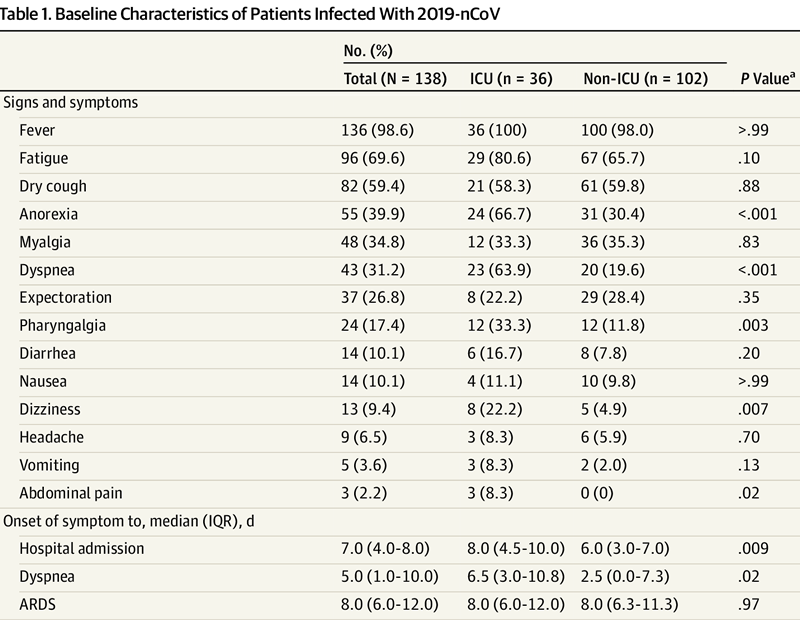
From: Clinical Characteristics of 138 Hospitalized Patients With 2019 Novel Coronavirus–Infected Pneumonia in Wuhan, China - JAMA, Wang et al., February vii, 2020
Findings from the Huang et al written report published on The Lancet and based on 41 hospitalized patients [three]
| COMMON SYMPTOMS | |
| Fever | 98% |
| Coughing | 76% |
| Myalgia (muscle pain) | 44% |
| LESS Common SYMPTOMS: | |
| Sputum production | 28% |
| Headache | 8% |
| Haemoptysis | 5% |
| Diarrhea | 3% |
Findings from the Chen et al study published on The Lancet and based on 99 hospitalized patients [four]
| Signs and symptoms at admission | ||
| Fever | 83% | |
| Cough | 82% | |
| Shortness of jiff | 31% | |
| Muscle ache | xi% | |
| Defoliation | 9% | |
| Headache | eight% | |
| Sore pharynx | 5% | |
| Rhinorrhoea (runny olfactory organ) | iv% | |
| Chest hurting | two% | |
| Diarrhea | 2% | |
| Nausea and vomiting | 1% | |
| More than 1 sign | 90% | |
| Fever, cough, | 15% | |
[back to top ↑]
Information on Coronavirus Symptoms from Government Health Officials
Canada Public Health Agency
The Canadian PHAC section dedicated to the 2019 novel coronavirus states that:
- Yous may have little to no symptoms.
- You may not know yous have symptoms of COVID-19 considering they are like to a cold or flu.
- Symptoms may take upwards to 14 days to appear after exposure to the virus. This is the longest known infectious period for this virus.
Symptoms accept included:
- fever
- cough
- difficulty breathing
- pneumonia in both lungs
In severe cases, infection can atomic number 82 to death.
U.k. Government and NHS
The UK National Health Service (NHS) section dedicated to Coronavirus (2019-nCoV) lists the following as the main symptoms of coronavirus:
- a coughing
- a high temperature
- shortness of breath
The GOV.United kingdom of great britain and northern ireland novel coronavirus guidance for the public page says:
- Typical symptoms of coronavirus include fever and a cough that may progress to a astringent pneumonia causing shortness of jiff and breathing difficulties.
The GOV.UK clinical guidance on Novel coronavirus (2019-nCoV): epidemiology, virology and clinical features notes that:
- Fever, coughing or chest tightness, and dyspnoea are the main symptoms reported. While most cases study a mild illness, astringent are likewise being reported, some of whom crave intensive care.
Australian Government
The Australian Government Department of Wellness informs that symptoms can range from mild illness to pneumonia, adding that some people will recover easily, while others may get very sick very quickly. According to their listing of novel coronavirus symptoms, people may experience:
- fever
- flu-like symptoms such as coughing, sore throat and fatigue
- shortness of breath
United States Centers for Disease Control and Prevention
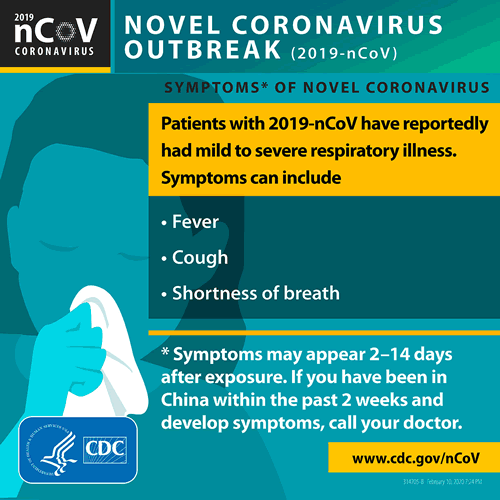
The CDC has published the following infographic on its Symptoms of Novel Coronavirus (2019-nCoV):
World Wellness Organization
The WHO has issued an interim guidance on the clinical management of suspected cases in which it says that
- "nCoV may nowadays with mild, moderate, or severe illness; the latter includes severe pneumonia, ARDS, sepsis and septic shock."
[back to top ↑]
Coronavirus Worldometer Sections:
- Coronavirus Update
- Case statistics and graphs
- Expiry statistics and graphs
- Mortality Rate
- Incubation Catamenia
- Historic period, Sex, Existing Condition
- Symptoms
- Countries with cases: basic list - detailed list
Sources
- Symptoms of Novel Coronavirus (2019-nCoV) - U.s. Centers for Affliction Control and Prevention (CDC)
- Clinical Characteristics of 138 Hospitalized Patients With 2019 Novel Coronavirus–Infected Pneumonia in Wuhan, Cathay - JAMA, Wang et al., February 7, 2020
- Clinical features of patients infected with 2019 novel coronavirus in Wuhan, China - Huang et al., The Lancet. January 24, 2020
- Epidemiological and clinical characteristics of 99 cases of 2019 novel coronavirus pneumonia in Wuhan, China: a descriptive written report - Chen et al, The Lancet, January thirty, 2020
- Report of the WHO-Mainland china Joint Mission on Coronavirus Disease 2019 (COVID-nineteen) [Pdf] - World Health System, February. 28, 2020
Source: https://www.worldometers.info/coronavirus/coronavirus-symptoms/
0 Response to "How Do You Know When You Get the Coronavirus"
Postar um comentário